Preparation Varies by Representative
Experienced sellers may know where to look and what to question. Newer or time-constrained representatives may enter the same kind of conversation with far less context.
CORPORATE SALES INTELLIGENCE · EXTERNAL RESEARCH CAPACITY
Quantum Leaps works behind your sales organization as an external intelligence desk. We monitor the markets and accounts leadership cares about, investigate meaningful developments, prepare decision-ready briefs and equip the appropriate representative with practical next actions.
Managers keep the priorities, coaching, relationships and decisions. We add the research capacity.
MORE RESEARCH CAPACITY · THE SAME SALES TEAM
Your strongest representatives often develop their own research habits, account knowledge and market awareness. The problem is that this level of preparation is difficult to reproduce consistently across every account, territory and seller.
Experienced sellers may know where to look and what to question. Newer or time-constrained representatives may enter the same kind of conversation with far less context.
Important developments may be scattered across territories, accounts, public records, company announcements and individual representative notes.
Representatives lose time locating information, reading long documents and determining whether a development is commercially relevant.
Quantum Leaps creates a more consistent external research and preparation layer without taking ownership away from the sales organization.
MANAGER VISIBILITY · REPRESENTATIVE PREPARATION
Monitor the agreed markets, territories, organizations and buying signals while maintaining context as developments accumulate.
Investigate priority organizations, decision environments, stakeholders, current initiatives, risks, unknowns and likely buying paths.
Translate the research into practical preparation without replacing the representative’s judgment or voice.
FROM MARKET CHANGE TO FIELD ACTION
ILLUSTRATIVE TEAM WORKFLOW
A regional employer announces a major expansion, increased hiring and a new operating facility.
The development may create needs involving payroll, workforce systems, benefits administration, technology, infrastructure, financing or professional services.
Leadership receives the evidence, likely timing, account fit, priority level, unanswered questions and recommendation on whether the account deserves attention.
The appropriate representative receives account context, verified developments, likely stakeholders, risks and the questions that should guide the conversation.
The representative receives relevant positioning, a credible reason to engage and a practical first-move direction.
The real sales conversation produces new information that may alter the priority, account strategy or monitoring profile.
Illustrative workflow only. A public development does not prove buyer intent, dissatisfaction, procurement activity or a resulting sales opportunity.
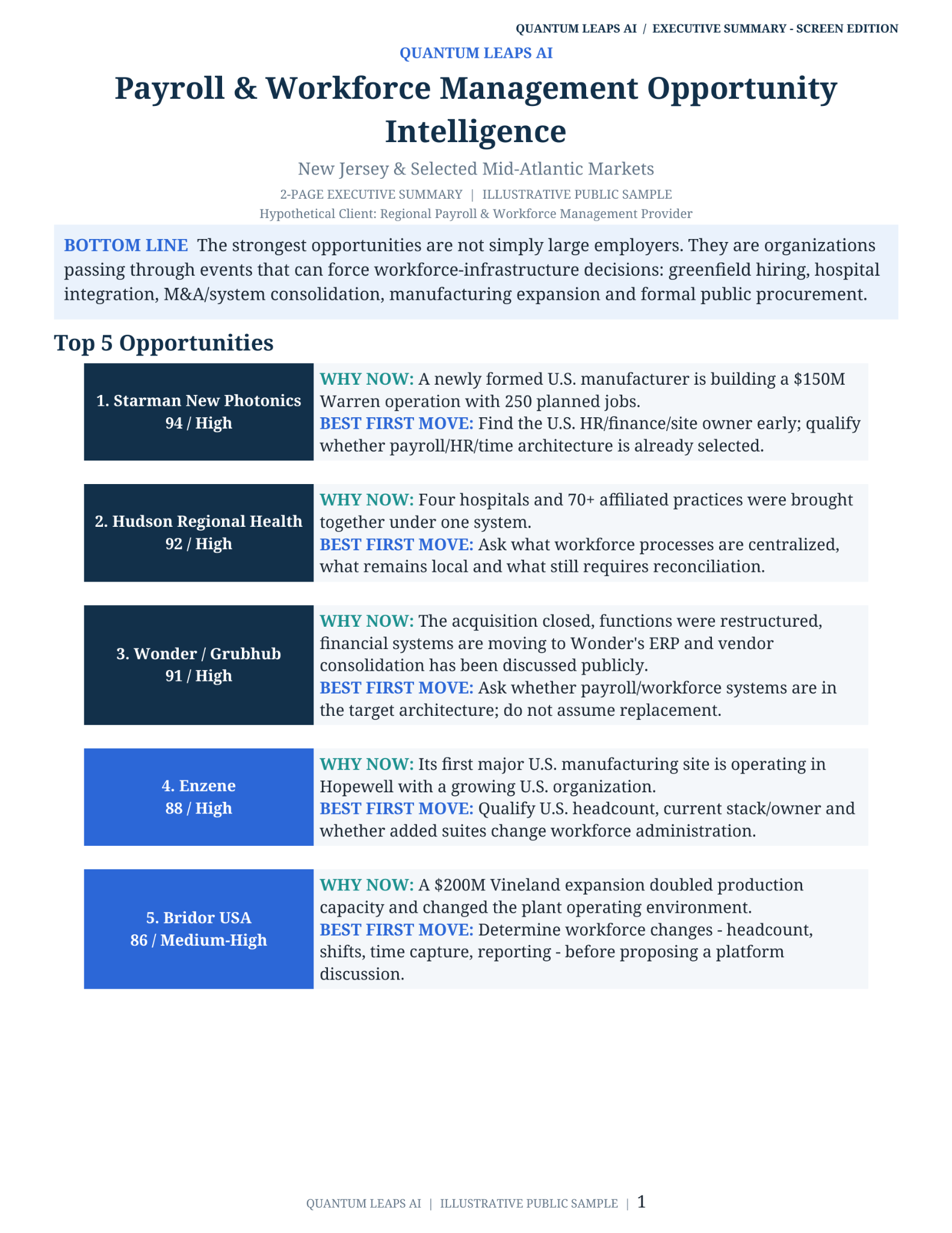
SEE THE FINISHED WORK
This existing public sample demonstrates how an external intelligence desk can give a sales team evidence-backed account priorities, the reason each organization may matter now, the risk of overclaiming and a credible first move for the representative.
Why nowA newly formed U.S. manufacturer is building a $150M Warren operation with 250 planned jobs.
Best first moveFind the U.S. HR/finance/site owner early; qualify whether payroll/HR/time architecture is already selected.
Why nowFour hospitals and 70+ affiliated practices were brought together under one system.
Best first moveAsk what workforce processes are centralized, what remains local and what still requires reconciliation.
Why nowThe acquisition closed, functions were restructured, financial systems are moving to Wonder's ERP and vendor consolidation has been discussed publicly.
Best first moveAsk whether payroll/workforce systems are in the target architecture; do not assume replacement.
The strongest opportunities are organizations passing through events that may force workforce-infrastructure decisions: greenfield hiring, integration, system consolidation, manufacturing expansion or formal procurement.
Closed procurements, unsupported replacement assumptions and poor-fit accounts should not automatically be treated as live opportunities.
The service connects the public signal to commercial timing, fit, evidence, uncertainty and the next justified question.
This illustrative public sample was prepared for a hypothetical client using publicly available information. Organizations mentioned have not necessarily expressed interest, and no affiliation, endorsement, buying intent or guaranteed outcome is implied. Findings are time-bound and should be reverified before sales action.
MEASURE WHAT CHANGES IN THE SALES MOTION
Representatives spend less time locating scattered external information and more time using it in real account conversations.
The team can redirect effort away from weak, mistimed or poorly supported pursuits before they consume unnecessary selling resources.
Managers and representatives enter important conversations with stronger context, sharper questions and a clearer understanding of what remains unknown.
A verified development can reach the appropriate person sooner instead of remaining buried in disconnected sources.
USE YOUR OWN ECONOMICS
This is an evaluation framework, not a promised return. Actual value depends on the client’s market, margins, sales execution, opportunity volume, timing and ability to win business.
CUSTOM TEAM ENGAGEMENTS
Sales organizations differ in territory structure, account complexity, opportunity volume, management needs and required delivery cadence. Team pricing is therefore built around the real coverage and research responsibility—not a generic software-seat count.
Number of territories or markets
Number and complexity of priority accounts
Number of representatives or account groups supported
Monitoring depth and source environment
Research and verification requirements
Delivery and alert cadence
Manager-level reporting requirements
Sales Activation and meeting-preparation support
SALES TEAMS & ORGANIZATIONS
A team engagement may begin with one manager, one representative group, one market, one territory or one defined account portfolio, then expand when broader coverage becomes useful.

LOW-FRICTION · CLIENT-SPECIFIC
The team receives usable intelligence, alerts and preparation without adopting another complicated software dashboard.
The initial intelligence process can be built primarily around public and commercially available sources together with appropriate context the client chooses to provide.
Research priorities, account strategy and Sales Activation materials are prepared around the agreed client engagement rather than presented as generic lead-list output.
Where appropriate, an engagement may define protection around named accounts, territories, product categories, services or customer segments.
Any protection is subject to existing commitments, defined in writing and is not universal, permanent or automatically included.
COMMON QUESTIONS
No. Sales leadership continues to set priorities, coach the team, direct account strategy and make commercial decisions. Quantum Leaps supplies additional research, monitoring, verification and preparation capacity.
Not necessarily. Shared intelligence can support broader management visibility, while individual representatives receive the account, territory or opportunity information relevant to their responsibilities.
No CRM or internal email access is required to begin. Initial work can be built primarily around public and commercially available information, together with appropriate context the client chooses to provide.
Yes. A team engagement can begin with one manager, representative group, territory, market, product category or account portfolio before broader coverage is considered.
Pricing reflects the actual coverage, account complexity, monitoring depth, research requirements, delivery cadence and support required. It is not based simply on software seats or logins.
No. Corporate Sales Intelligence can improve awareness, preparation, prioritization and decision-making, but it cannot guarantee buyer intent, procurement outcomes, contracts, revenue or closed sales.
Yes. Research and monitoring priorities may shift as accounts, meetings, projects and market developments change, provided the work remains within the agreed scope.
MORE RESEARCH CAPACITY · THE SAME SALES TEAM
Tell us what your team sells, who buys it, where your representatives compete and what sales leadership needs to see more clearly. We will discuss the most practical territory, account and delivery scope.
SALES PROFESSIONALS & TEAMS · CUSTOMER & TEAM SUPPORT
Choose a customer assistant, a staff assistant, or both. Each is built around the information, people, and procedures you approve.
CUSTOMER ASSISTANT
Help prospects explore approved product information, compare options, and prepare a useful demonstration or sales inquiry.
Discuss customer support →STAFF & OPERATIONS ASSISTANT
Help representatives learn the product line, find approved sales guidance, prepare for meetings, and bring unresolved questions to the sales manager.
Discuss staff support →Explain approved product positioning, demonstration procedures, and internal handoff steps.
Find approved reference material, qualification checklists, and questions requiring technical confirmation.
Organize recurring objections, missing product information, follow-up needs, and team training questions.
Employer-approved product documents, sales playbooks, demonstration checklists, and technical escalation contacts.
A protected employee link can open from a phone, shared tablet, or workplace QR code. Customer and internal knowledge are kept separate. Report collection, manager briefings, and notifications are configured and tested when included in your scope.